

Clients often ask us how a project actually runs once they sign on. Here's the honest, unglamorous version of our process.
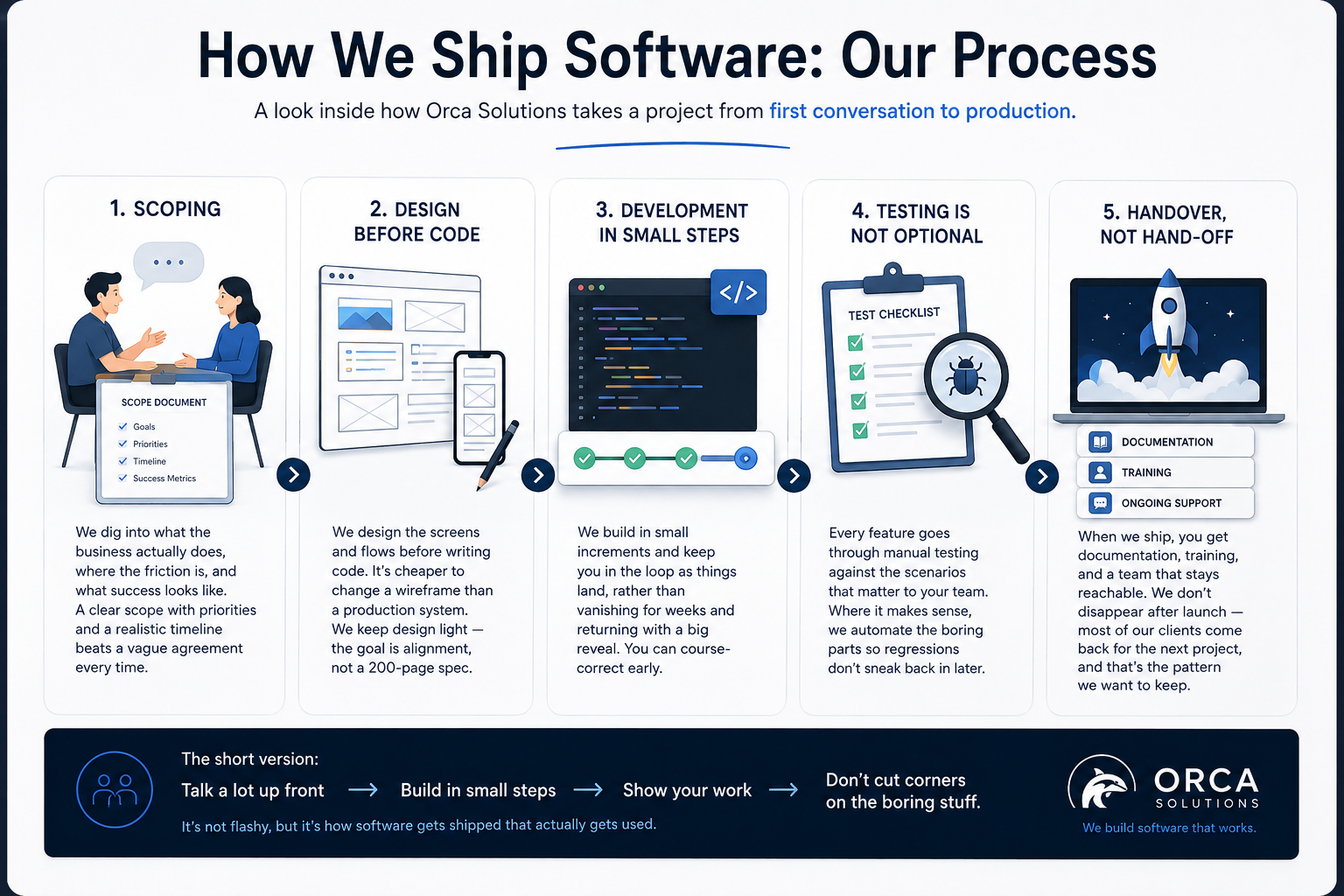
1. Scoping
Everything starts with a conversation. We dig into what the business actually does, where the friction is, and what success looks like. We write this down — a clear scope document with priorities and a realistic timeline beats a vague agreement every time.
2. Design before code
For anything user-facing, we design the screens and flows before writing code. It's cheaper to change a wireframe than a production system. We keep design lightweight — the goal is alignment, not a 200-page spec.
3. Development in small, visible steps
We build in small increments and keep you in the loop as things land, rather than vanishing for weeks and returning with a big reveal. This means you can course-correct early, when it's still cheap to do so.
4. Testing is not optional
Every feature goes through manual testing against the scenarios that matter to your team. Where it makes sense, we automate the boring parts so regressions don't sneak back in later.
5. Handover, not hand-off
When we ship, you get documentation, training, and a team that stays reachable. We don't disappear after launch — most of our clients come back for the next project, and that's the pattern we want to keep.
The short version: talk a lot up front, build in small steps, show your work, and don't cut corners on the boring stuff. It's not flashy, but it's how software gets shipped that actually gets used.