
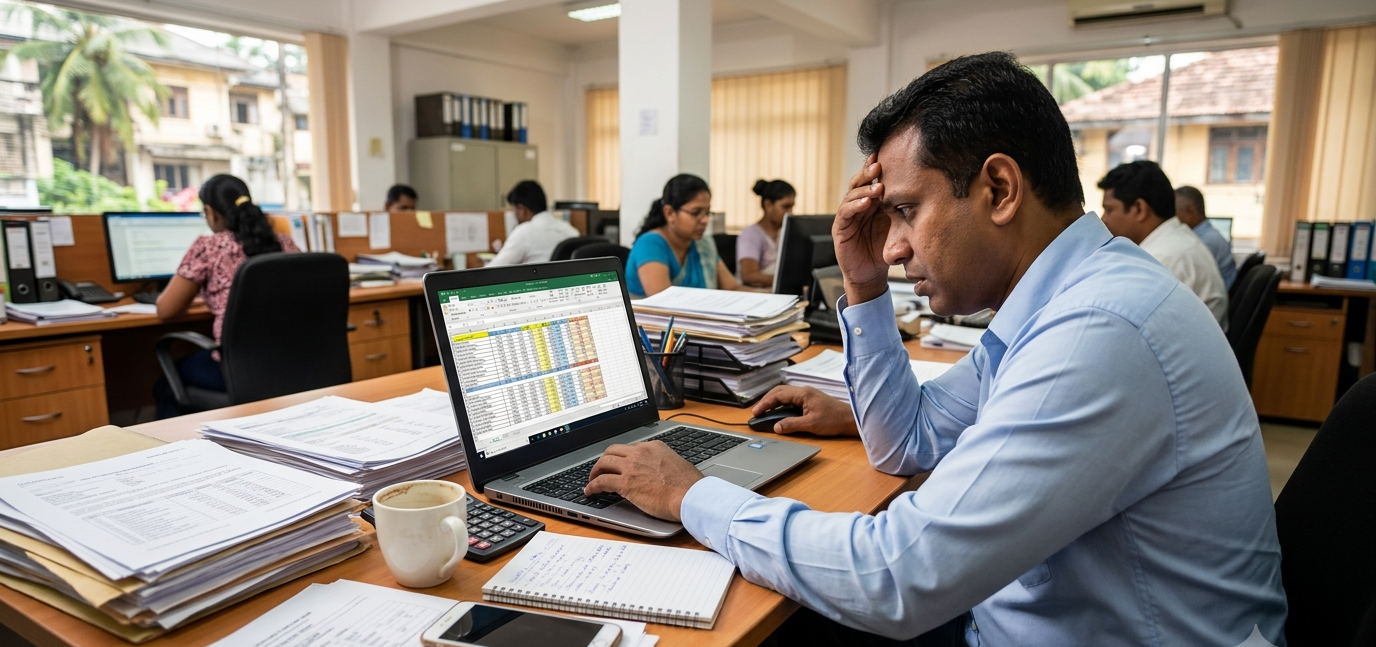
It starts innocently. A single workbook your accountant set up in 2015. Then your store added a column. Then another sheet. Then your warehouse manager built a lookup that half-works. Ten years later, that same Excel file is quietly running your business — and it's costing you more than you think.
This is the most common story we hear from Sri Lankan businesses — manufacturers, distributors, retailers, and service companies. It's also why so many of them end up talking to us about an ERP. But before we get there, let's be honest about what Excel actually costs.
The quiet cost: hours of admin nobody bills
Every time data has to be copied, retyped, or pasted between sheets, someone is paying for it. The daily ritual of "update the master sheet," "send the report on WhatsApp," "reconcile the totals" — that's not work, it's tax. For a mid-sized company, that's easily a person's day, every single week.
The expensive cost: errors you can't see
A formula that's one row off. A paste that lands in the wrong column. A totals sheet that doesn't match the invoice. When your numbers disagree with your numbers, you spend days hunting for the typo instead of running the business. Every reconciliation becomes a small emergency.
The risky cost: everything lives in one person's head
The person who built the workbook leaves — maternity leave, a better offer, retirement — and suddenly the business doesn't understand its own data. We've seen companies unable to produce a simple stock report for a month because "the person who knows the file" was away.
So when is it actually time to move?
Excel isn't evil. For a small operation, a spreadsheet is the right tool. You're probably ready to graduate when you see three things: more than one person editing the same data, numbers that disagree with each other, and admin work that keeps someone away from the work that makes money.
What graduation looks like
It doesn't have to be a six-month ERP project. For most businesses it starts small — one database, a few workflows, a proper report. The system grows with you instead of you growing around a spreadsheet.
If this sounds familiar, we've built this exact system for manufacturers and retailers across Sri Lanka — from warehouse to invoicing to accounting. Have a look at what an ERP project looks like at VISAL ERP, or just start the conversation.